FastAPI Integration
userharbor-fastapi provides a FastAPI adapter for UserHarbor. It exposes
account-management routes and dependency helpers while keeping user storage,
email delivery, password hashing, token generation, and account rules in
UserHarbor core and the configured integrations.
Repository:
Installation
You can also install it through the core package extra:
Or install all official adapters together:
The package depends on userharbor and FastAPI.
Install storage and email adapters separately. For example:
What it provides
The adapter provides:
- a FastAPI
APIRouter - account routes for registration, email verification, login, logout, password reset, password change, and account deletion
- bearer session token authentication
- current-user and optional-user dependencies
- role and permission dependencies
- UserHarbor exception to HTTP error mapping
- configurable user serialization for route responses
It does not provide a database implementation or email delivery implementation.
Pass a configured UserHarbor instance that already has a UserStore and
EmailSender.
Basic usage
from fastapi import Depends, FastAPI
from userharbor import UserHarbor
from userharbor_fastapi import UserHarborFastAPI


harbor = UserHarbor(
    secret_key="your-secret-key",
    store=store,
    email_sender=email_sender,
)

auth = UserHarborFastAPI(harbor)

app = FastAPI()
app.include_router(auth.router, prefix="/auth", tags=["auth"])


@app.get("/me")
def me(user=Depends(auth.current_user)):
    return user


@app.get("/admin")
def admin(user=Depends(auth.require_role("admin"))):
    return user


@app.get("/billing")
def billing(user=Depends(auth.require_permission("billing.read"))):
    return user
Built-in routes
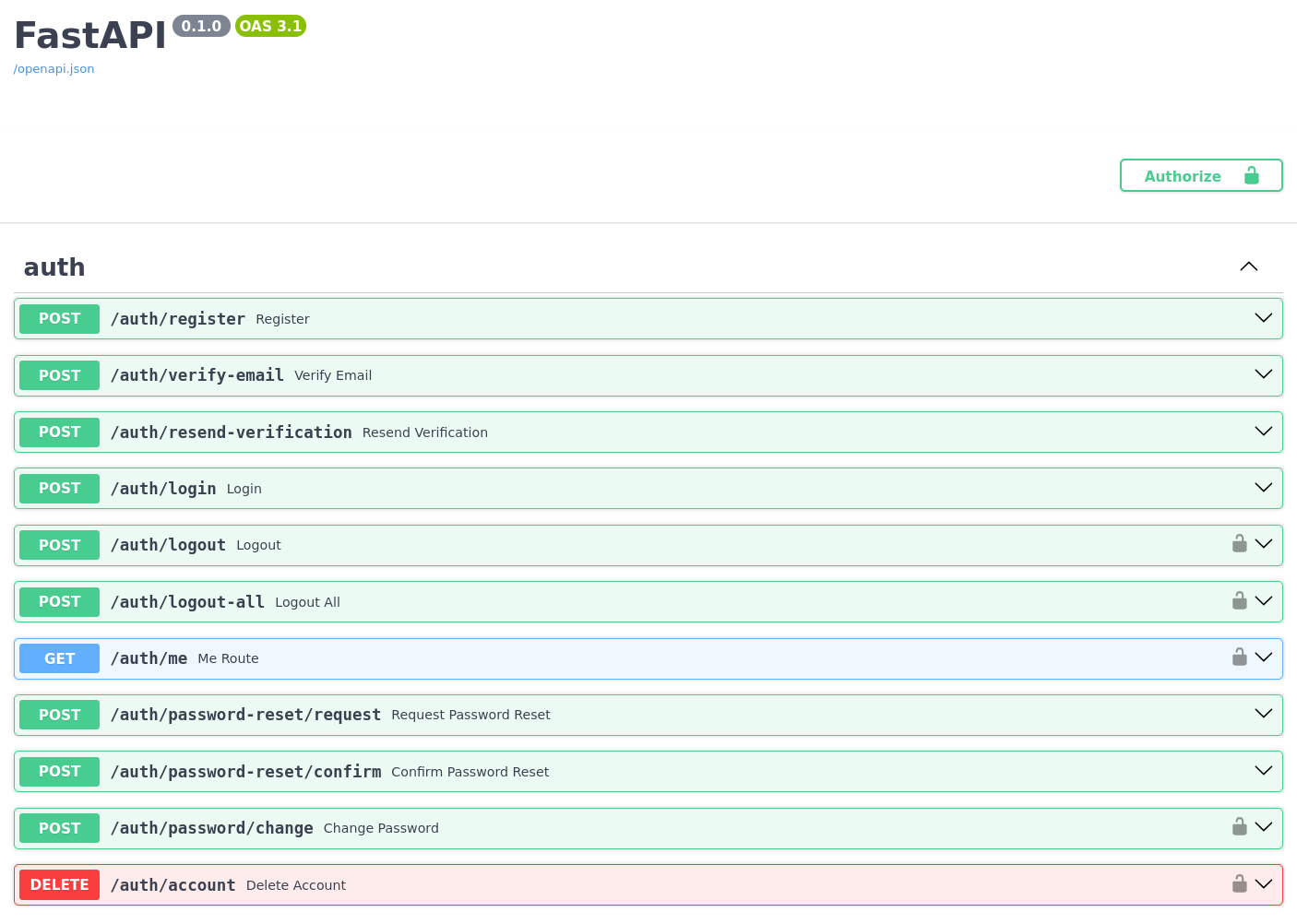
The adapter exposes these routes through auth.router:
POST   /register
POST   /verify-email
POST   /resend-verification
POST   /login
POST   /logout
POST   /logout-all
GET    /me
POST   /password-reset/request
POST   /password-reset/confirm
POST   /password/change
DELETE /account
Mount the router under the prefix used by your application:
With that prefix, the login route is available at /auth/login, the current
user route at /auth/me, and so on.
The routes are also visible in FastAPI's generated Swagger UI:
Authentication
POST /login returns a bearer-compatible response:
Send the session token on protected requests:
The token is the UserHarbor session token returned by harbor.login().
Dependencies
Use auth.current_user when a route requires a valid session:
Use auth.optional_user when authentication should be optional:
@app.get("/homepage")
def homepage(user=Depends(auth.optional_user)):
    return {"authenticated": user is not None}
Use role and permission dependencies for authorization:
@app.get("/admin")
def admin(user=Depends(auth.require_role("admin"))):
    return user


@app.get("/invoices")
def invoices(user=Depends(auth.require_permission("billing.invoices.read"))):
    return user
auth.require_role() and auth.require_permission() return the current user
when authorization succeeds. They map invalid or expired sessions to
authentication errors and missing roles or permissions to authorization errors.
User serialization
By default, /me returns the public UserHarbor user fields:
Pass user_serializer when your application returns a richer user object from
its store and wants to expose a custom public response shape:
auth = UserHarborFastAPI(
    harbor,
    user_serializer=lambda user: {
        "username": user.username,
        "email": user.email,
        "verified": user.verified,
        "display_name": user.display_name,
    },
)
The serializer is used by the built-in /me route.
Error responses
UserHarbor exceptions are converted into structured FastAPI errors:
The adapter maps common failures as follows:
- invalid credentials and invalid sessions return
401 Unauthorized - valid sessions without the required role or permission return
403 Forbidden - unknown roles and permissions return
404 Not Found - invalid input and invalid verification or password reset tokens return
400 Bad Request - username conflicts return
409 Conflict
Combining official adapters
A typical FastAPI application can combine the official SQLAlchemy, SMTP, and FastAPI integrations:
import os

from fastapi import FastAPI
from sqlalchemy import create_engine
from sqlalchemy.orm import sessionmaker
from userharbor import UserHarbor
from userharbor_fastapi import UserHarborFastAPI
from userharbor_smtp import SMTPEmailSender
from userharbor_sqlalchemy import SQLAlchemyUserStore


engine = create_engine("sqlite:///users.db")
SessionLocal = sessionmaker(bind=engine)

store = SQLAlchemyUserStore(SessionLocal)
store.metadata.create_all(engine)

email_sender = SMTPEmailSender(
    host=os.getenv("HOST", "smtp.example.com"),
    port=int(os.getenv("PORT", 587)),
    username=os.getenv("USERNAME"),
    password=os.getenv("PASSWORD"),
    from_email=os.getenv("USERNAME", ""),
)

harbor = UserHarbor(
    secret_key="your-secret-key",
    store=store,
    email_sender=email_sender,
)

auth = UserHarborFastAPI(harbor)

app = FastAPI()
app.include_router(auth.router, prefix="/auth", tags=["auth"])


if __name__ == "__main__":
    import uvicorn

    uvicorn.run(app, host="0.0.0.0", port=8000)
In production applications, use your normal configuration system for secrets, SMTP credentials, and database URLs.